Mammalia |
Cetartiodactyla |
Delphinidae
Ambiente: milieu / zona climática / intervalo de profundidade / gama de distribuição
Ecologia
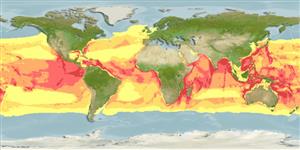
Pelágico(a,os,as); oceanódromo (Ref. 75906); intervalo de profundidade 0 - 4330 m (Ref. 116169). Tropical; 90°N - 90°S, 180°W - 180°E
Atlantic Ocean and Indo-Pacific: Stenella longirostris longirostris: Around oceanic islands in the tropical Atlantic, Indian, Western and Central Pacific east to about 145°W. Tropical, subtropical.
Comprimento na primeira maturidade / Tamanho / Peso / Idade
Maturidade: Lm 164.1, range 152 - 182 cm Max length : 240 cm TL macho/indeterminado; (Ref. 1394); 200 cm TL (female); peso máx. Publicado: 77.0 kg (Ref. 1394)
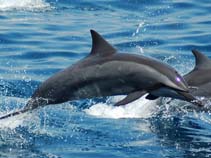
Spinner dolphins have various forms depending on their geographical locations. Commonly, these are small and slender animals that have a relatively long slender beak. It has a tripartite coloration which consists of a dark grey dorsal cape, lighter grey lateral field and a white or very light ventral field. A dark band runs from the eye to the flipper, bordered above by a thin line. It has a clearly discernible contrast of cape with the lateral field and a smooth curve on the ventral margin of cape over the eye. The ventral white field extends dorsal variably nearly to level of eye; margin speckled; genital and axillary areas confluent. It also has a high to medium contrast between flipper band and gular region wherein variable spots are visible. Its flippers are dark or speckled. In adult males the dorsal fin is falcate to triangular and has a small to medium protuberant ventral keel.
Dolphins are directly caught for use as shark-bait in Sta. Ana and Aparri, Philippines (Ref. 77119). Reside in coastal waters (Ref. 97368). May seek shelter in shallow sandy bottoms to protect themselves from predators (Ref. 80498). Observed year-round during daytime in sheltered bays or within lagoons. Forming schools ranging in size from 15 to 30 individuals to as large as 100 to 140 individuals (Ref. 97372). Feeds predominantly at night on deeper, offshore waters (Ref. 122680) and rest during much of the day (Ref. 1394); on small (5 to 10 cm long) fishes, shrimps, and squid in deep offshore waters from the mesopelagic boundary. Follows the diel horizontal migration as well as the vertical migrations of its prey (Refs. 97368).
Ciclo de vida e comportamento de acasalamento
Maturidade | Reprodução | Desova | Ovos | Fecundidade | Larvas
Sexual maturity attained between 4 to 7 years (females, 165-170 cm) and 7 to 10 years (males, 160-180 cm). Promiscuous, with observable courtship display. Gestation period averages 10 months, produces only one calf. Born at 3-year intervals, calves are nursed for at least a year and weaned between 1 to 3 years (Ref. 80521).
Tan, J.M.L. 1995 A Field Guide to the Whales and Dolphins in the Philippines. Makati City: Bookmark. 125 p. (Ref. 936)
Categoria na Lista Vermelha da IUCN
(Ref. 130435: Version 2025-2 (Global))
Categoria CITES (Ref. 108899)
Ameaça para o homem
Utilização humana
Pescarias: espécies comerciais
FAO - pescarias: perfil da espécie, landings search; Publication: search | FishSource | Sea Around Us
Ferramentas
Mais informação
FisiologiaConsumo de oxigénio
Relacionado com o ser humanoSelos, moedas, diversos.
Fontes da internet
Estimativas baseadas em modelos
Resiliência
(Ref. 69278): |
Elevada, tempo mínimo de duplicação da população menor que 15 meses (K=0.41-0.54; tm=5) |
Vulnerabilidade da pesca
(Ref. 71543) |
High to very high vulnerability (71 of 100). |
Categoria de preço
(Ref. 80766): |
Unknown. |