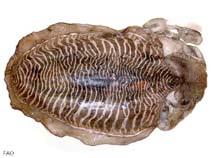
Cephalopoda |
Sepiida |
Sepiidae
Entorno: milieu / zona climática / rango de profundidad / gama de distribución
Ecología
Benthic; rango de profundidad 0 - 130 m (Referencia 1695), usually ? - 40 m (Referencia 275). Tropical; 41°N - 26°S, 32°E - 151°E (Referencia 1695)
Distribución
Territories | Áreas FAO | Ecosistemas | Ocurrencias, apariciones | Introducciones
Indo-West Pacific and the Mediterranean Sea: from Red Sea to Japan and Australia.
Longitud en la primera madurez / Tamaño / Peso / Edad
Madurez: Lm 12.2, range 5 - 24 cm Max length : 43.0 cm ML macho / no sexado; (Referencia 275); 33 cm ML (female); peso máximo publicado: 5.0 kg (Referencia 275); peso máximo publicado: 5.0 kg
Common sizes in landings range from 15 to 20 cm (Ref. 3722). This species supports industrial or artisanal fisheries throughout its range. Mostly fished and abundant in Gulf and the Andaman Sea. This species has been grown successfully in culture and techniques are being developed to culture the animals commercially (Ref. 1695). Minimum depth from Ref. 103582. Benthic (Ref. 105085). Epibenthic (Ref. 116259). Most common in shallow coastal waters (Ref. 801). Commonly found over sand and seagrass beds (Ref. 102838). Active predator and exhibits cannibalism (Ref. 105085). Feeds on crustaceans, small fish (Refs. 801, 9773) and cephalopods (Ref. 105085). Able to change color rapidly (Ref. 102838). Coastal demersal. Forms groups during spawning at depths of at most 20m (Ref. 9773).
Members of the class Cephalopoda are gonochoric. Male and female adults usually die shortly after spawning and brooding, respectively. Mating behavior: Males perform various displays to attract potential females for copulation. During copulation, male grasp the female and inserts the hectocotylus into the female's mantle cavity where fertilization usually occurs. Life cycle: Embryos hatch into planktonic stage and live for some time before they grow larger and take up a benthic existence as adults.
Jereb, P. and C.F.E. Roper (eds.) 2005 Cephalopods of the world. An Annotated and Illustrated catalogue of Cephalopod species known to date. Vol. 1. Chambered nautiluses and sepioids (Nautilidae, Sepiidae, Sepiolidae, Sepiadariidae, Idiosepiidae and Spirulidae). FAO Spec. Cat. Fish. Purp. 4(1):262p. Rome: FAO. (Referencia 1695)
Situación en la Lista Roja de la UICN
(Referencia 130435: Version 2025-2 (Global))
Estatus CITES (Referencia 108899)
Not Evaluated
CMS (Referencia 116361)
Not Evaluated
Amenaza para el ser humano
Usos humanos
Pesquerías: comercial; Acuicultura: comercial; Acuario: Potencial
FAO - Publication: search | FishSource |
Herramientas
Más información
FisiologíaConsumo del oxígeno
Relacionados con el ser humanoSellos, monedas, varios
Fuentes de Internet
Estimaciones basadas en modelos
Resiliencia
(Ref. 69278): |
Alto, población duplicada en un tiempo mínimo inferior a 15 meses (K=0.46-1.69) |
Vulnerabilidad pesquera
(Referencia 71543) |
Low vulnerability (22 of 100). |
Categoría de precios
(Referencia 80766): |
High. |