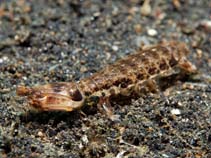
Malacostraca |
Stomatopoda |
Pseudosquillidae
Environment: milieu / climate zone / depth range / distribution range
Ecology
Benthic; depth range 1 - 150 m (Ref. 80410). Tropical
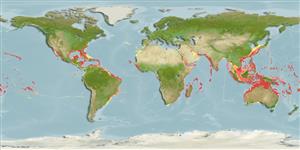
Circumtropical.
Length at first maturity / Size / Weight / Age
Maturity: Lm ? range ? - ? cm Max length : 9.0 cm TL male/unsexed; (Ref. 3099)
Maximum depth from Ref. 96667. Found on seagrass beds and coral rubble cavities (Ref. 80410, 83920), particularly in subtidal and intertidal areas (Ref. 83920).
Life cycle and mating behavior
Maturity | Reproduction | Spawning | Eggs | Fecundity | Larvae
Some members of the order Stomatopoda pair for life and some come together only to mate. Males produce sperm ducts rather than spermatophores; females can brood a maximum of 50,000 eggs. Life cycle: Eggs hatch to a planktonic zoea which lasts for 3 months.
Coelho Filho, P.A. 2004 Análise do macrobentos na plataforma continental externa e bancos oceânicos do nordeste do Brasil no âmbito do programa REVIZEE. Grupo de estudo do Bentos (Oceanografia Biológica), Programa REVIZEE. 81 p. (Ref. 2364)
IUCN Red List Status
(Ref. 130435: Version 2025-2 (Global))
CITES status (Ref. 108899)
Not Evaluated
Not Evaluated
Threat to humans
Human uses
FAO - Publication: search | FishSource |
Tools
More information
Trophic EcologyFood items (preys)Diet compositionFood consumptionPredators Population dynamicsGrowthMax. ages / sizesLength-weight rel.Length-length rel.Length-frequenciesMass conversionAbundance Life cycleReproductionMaturityFecunditySpawningEggsEgg developmentLarvae PhysiologyOxygen consumption
Human RelatedStamps, coins, misc.
Internet sources
Estimates based on models
Fishing Vulnerability
(Ref. 71543) |
Low vulnerability (10 of 100). |
Price category
(Ref. 80766): |
Unknown. |