Bivalvia |
Mytilida |
Mytilidae
Môi trường: môi trường / vùng khí hậu / Mức độ sâu / phạm vi phân phối
Sinh thái học
Benthic; mức độ sâu 0 - 50 m (Tài liệu tham khảo 101292). Tropical; 10°C - 30°C (Tài liệu tham khảo 113750), preferred 26°C (Tài liệu tham khảo 107945); 37°N - 35°S, 64°W - 82°E
Western Indian Ocean, Atlantic Ocean and the Mediterranean Sea: from the southern Caribbean to Uruguay, eastern Atlantic from Portugal to Senegal, and Congo to South Africa, and in the western Indian Ocean from South Africa to Sri Lanka. Introduced in the Gulf of Mexico. Tropical and subtropical.
Chiều dài lúc trưởng thành đầu tiên / Bộ gần gũi / Khối lượng (Trọng lượng) / Tuổi
Chín muồi sinh dục: Lm ? range ? - ? cm Max length : 17.0 cm SHL con đực/không giới tính; (Tài liệu tham khảo 271)
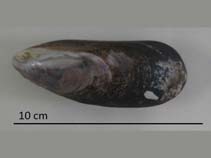
Shell mussel-shaped, ventral margin straight, posterior end rounded. Shell surface smooth except for fine growth lines. Hinge 1 or 2 teeth. Periostracum flaky. Colour: externally brown or light brown with concentric yellow bands near ventral margin, internally purple, nacreous.
It is heavily exploited commercially, stocks are dwindling in southernmost part or range. Consumed boiled in juices, marinated, grilled with rice, or in a number of different local dishes. Canned industrially (Ref. 271). Minimum depth from Ref. 104365. It is attached by byssus onto hard substrates, common in high-energy rocky coasts (Ref. 271). Feeds primarily on detritus (Ref. 114808).
Vòng đời và hành vi giao phối
Chín muồi sinh dục | Sự tái sinh sản | Đẻ trứng | Các trứng | Sự sinh sản | Ấu trùng
Members of the class Bivalvia are mostly gonochoric, some are protandric hermaphrodites. Life cycle: Embryos develop into free-swimming trocophore larvae, succeeded by the bivalve veliger, resembling a miniature clam.
Carpenter, K.E. (ed.) 2002 The living marine resources of the Western Central Atlantic. Volume 1: Introduction, molluscs, crustaceans, hagfishes, sharks, batoid fishes, and chimaeras. FAO Species Identification Guide for Fishery Purposes and American Society of Ichthyologists and Herpetologists Special Publication No. 5, Rome. 600p. (Tài liệu tham khảo 271)
Tình trạng Sách đỏ IUCN
(Tài liệu tham khảo 130435: Version 2025-2 (Global))
tình trạng CITES (Tài liệu tham khảo 108899)
Not Evaluated
CMS (Tài liệu tham khảo 116361)
Not Evaluated
Mối đe dọa đối với con người
Sử dụng của con người
Các nghề cá: tính thương mại cao
FAO - Aquaculture Systems: production searchCác nghề cá: landings search; Publication: search | FishSource | Biển chung quanh ta
Các công cụ
Thêm thông tin
Vòng đờiSự tái sinh sảnChín muồi sinh dụcSự sinh sảnĐẻ trứngCác trứngSự phát triển của trứngẤu trùng Sinh lý họcThành phần ô-xy
Liên quan đến con ngườiTem, tiền xu, v.v.
Các nguồn internet
Ước tính dựa trên mô hình
Thích nghi nhanh
(Ref. 69278): |
Chiêù cao, thời gian nhân đôi của chủng quần tối thiểu là dưới 15 tháng (K=0.06-1.5) |
Sự dễ bị tổn thương của nghề đánh cá
(Tài liệu tham khảo 71543) |
Low to moderate vulnerability (29 of 100). |
Sự dễ bị tổn thương của khí hậu
(Tài liệu tham khảo 125649) |
Moderate to high vulnerability (51 of 100) |
Loại giá
(Tài liệu tham khảo 80766): |
Medium. |
Nutrients
|
Calcium = 149 [71, 228] mg/100g; Iron = 8.53 [1.95, 15.11] mg/100g; Protein = 9.88 [8.64, 11.12] %; Omega3 = 0.313 [0.202, 0.423] g/100g; Selenium = 61 [50, 72] μg/100g; VitaminA = 0 μg/100g; Zinc = 2.04 [0.56, 3.51] mg/100g (wet weight); based on nutrient studies. |