Hexacorallia |
Scleractinia |
Agariciidae
Ambiente: milieu / zona climática / intervalo de profundidade / gama de distribuição
Ecologia
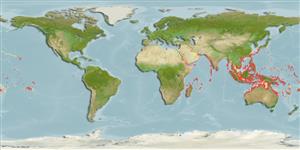
Associadas(os) a recifes; intervalo de profundidade 0 - 40 m (Ref. 847). Tropical; 36°N - 29°S, 32°E - 137°W (Ref. 847)
Indo-Pacific.
Comprimento na primeira maturidade / Tamanho / Peso / Idade
Maturidade: Lm ? range ? - ? cm
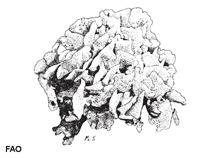
Small colonies are encrusting, and larger ones develop vertical plates that anastomose to form an interlocking matrix. The sides and edges of the plates are quite smooth. Individual corallites are tiny, superficial and run in irregular rows (Ref. 269).
Common in shallow to intermediate depths and may form colonies several meters in diameter and in height (Ref. 269). Common in shallow to intermediate depths (Ref. 269) in most reef habitats (Ref. 98471). Growth varies with water conditions: large, thin plates in clear shelter waters; thick plates in exposed areas; and minimal ridges form in high turbidity. The bivalve Barbatia helblingi was reported to be byssally attached, wedged between the plates of this coral (Ref. 130769).
Ciclo de vida e comportamento de acasalamento
Maturidade | Reprodução | Desova | Ovos | Fecundidade | Larvas
Members of the class Anthozoa are either gonochoric or hermaphroditic. Mature gametes are shed into the coelenteron and spawned through the mouth. Life cycle: The zygote develops into a planktonic planula larva. Metamorphosis begins with early morphogenesis of tentacles, septa and pharynx before larval settlement on the aboral end.
Hodgson, G. 1998 Corals. p. 101-122. In Carpenter, K.E. and V.H. Niem (eds) FAO species identifidication guide for fishery purposes. The living marine resources of the Western Central Pacific. Vol. 1. Seaweeds, coral, bivalves and gastropods. FAO Rome. (Ref. 269)
Categoria na Lista Vermelha da IUCN
(Ref. 130435: Version 2025-2 (Global))
Categoria CITES (Ref. 108899)
Not Evaluated
Ameaça para o homem
Utilização humana
FAO - Publication: search | FishSource |
Ferramentas
Mais informação
Ecologia TróficaProdutos alimentares (presas)Composição da dietaConsumo alimentarPredadores Dinâmica das populaçõesCrescimento
Idades / tamanhos máximos
Comprimento-peso rel.
Comprimento-comprimento rel.
Frequência de comprimento
Conversão de massa
Abundância
Ciclo de vidaReproduçãoMaturidadeFecundidadeDesovaOvosDesenvolvimento dos ovosLarvas FisiologiaConsumo de oxigénio
Relacionado com o ser humanoSelos, moedas, diversos.
Fontes da internet
Estimativas baseadas em modelos
Vulnerabilidade da pesca
(Ref. 71543) |
(0 of 100). |
Categoria de preço
(Ref. 80766): |
Unknown. |