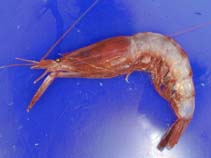
Malacostraca |
Decapoda |
Pasiphaeidae
Milieu: milieu / Klimaatzone / Diepte / verspreidingsgebied
Ecologie
Bathypelagisch; diepte 10 - 2000 m (Ref. 8126), usually 400 - 400 m. Subtropical; 76°N - 16°N, 75°W - 37°E
Arctic, Atlantic Ocean and the Mediterranean: from Boothia Peninsula, Canada to Mauritania, east to the Mediterranean.
Lengte bij maturiteit / Grootte / Gewicht / Leeftijd
Maturiteit: Lm ? range ? - ? cm Max length : 10.5 cm TL mannelijk / geslacht onbekend; (Ref. 8136); 4.54 cm CL (female)
Benthopelagic. Juveniles carry out actual vertical migrations while adults undertake epibenthic movements along the bottom (Ref. 105772). Found in the continental shelf (Refs. 79119, 78232), upper and middle slope (Refs. 78232, 105341). Predatory activity occurs higher in the water column at night. Bases its diet on mesopelagic fishes and juvenile cephalopods, decapods, and euphausiids. However nocturnal diet is observed and includes gammarid amphipods, isopods, and macruran decapods (Ref. 105773).
Levenscyclus en paargedrag
Maturiteit | Voortplanting | Paaien | Eieren | Fecunditeit | Larven
Members of the order Decapoda are mostly gonochoric. Mating behavior: Precopulatory courtship ritual is common (through olfactory and tactile cues); usually indirect sperm transfer.
Hayashi, K.-I. 2006 Revision of the Pasiphaea alcocki species group (Crustacea, Decapoda, Pasiphaeidae). p. 193-241. In B. Richer de Forges and J.-L. Justine (eds) Tropical deep-sea benthos. Mémoires du Muséum national d'Histoire naturelle 24(193). (Ref. 8126)
Status op de Rode Lijst van het IUCN
(Ref. 130435: Version 2025-2 (Global))
CITES status (Ref. 108899)
Not Evaluated
Not Evaluated
Gevaar voor de mens
Gebruik door de mens
Visserij: commercieel
FAO - Publication: search | FishSource |
Tools
Meer informatie
LevenscyclusVoortplantingMaturiteitFecunditeitPaaienEierenOntwikkeling van de eierenLarven FysiologieZuurstofverbruik
Menselijk gerelateerdPostzegels, munten, diversen.
Internetbronnen
Schattingen op basis van modellen
Weerstandsvermogen
(Ref. 69278): |
Hoog, minimale populatieverdubbelingstijd minder dan 15 maanden (K=0.77-0.85) |
Kwetsbaarheid van de visserij
(Ref. 71543) |
Low vulnerability (10 of 100). |
Prijsklasse
(Ref. 80766): |
Unknown. |