Cephalopoda |
Octopoda |
Octopodidae | Octopodinae
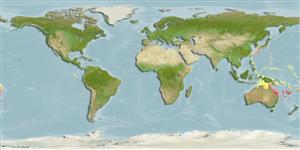
Meio ambiente: milieu / Zona climática / intervalo de profundidade / faixa de distribuição
Ecologia
Benthic; intervalo de profundidade 1 - 54 m (Ref. 96968). Tropical
Pacific Ocean.
Comprimento de primeira maturação / Tamanho / Peso / Idade
Maturidade: Lm ? range ? - ? cm Max length : 32.0 cm TL macho/indeterminado; (Ref. 96968); peso máx. publicado: 300.00 g (Ref. 96968)
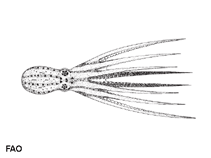
Its mantle length is 10 cm (Ref. 96968). Depths range from 1 to 54 m. Occurs on sandy substrates, often associated with coral heads or rubble. Deep lairs are excavated under coral heads or coral rubble on sand substrate. Appears to have crepuscular activity patterns. Lairs are surrounded by cast off gastropod shells which may have been collected for their secondary occupants, hermit crabs. Stomach contents have a high proportion of crustacean exoskeletal fragments. Eggs are laid in large numbers in festoons. The small egg size indicates hatchlings are planktonic. Possibly venomous based on the prominent warning coloration and being locally known as the "poison octopus". Live animals observed to bite objects willingly, uncommon amongst octopuses (Ref. 96968).
Ciclo de vida ou comportamento de acasalamento
Maturidade | Reprodução | Desova | Ovos | Fecundidade | Larvas
Members of the class Cephalopoda are gonochoric. Male and female adults usually die shortly after spawning and brooding, respectively. Mating behavior: Males perform various displays to attract potential females for copulation. During copulation, male grasp the female and inserts the hectocotylus into the female's mantle cavity where fertilization usually occurs. Life cycle: Embryos hatch into planktonic stage and live for some time before they grow larger and take up a benthic existence as adults.
Norman, M.D. and C.C. Lu 2000 Preliminary checklist of the cephalopods of the South China Sea. The Raffles Bulletin of Zoology 8:539-567. (Ref. 81752)
Status na Lista Vermelha da UICN
(Ref. 130435: Version 2025-2 (Global))
Status no CITES (Ref. 108899)
Not Evaluated
Not Evaluated
Ameaça para os humanos
Uso pelos humanos
FAO - Publication: search | FishSource |
Ferramentas
Mais informação
Dinâmica populacionalCrescimento
Idade máxima / tamanhos
Relação comprimento-peso.
Relação comprimento-comprimento.
Frequências de comprimento
Conversão de massa
Abundância
Ciclo de vidaReproduçãoMaturidadeFecundidadeDesovaOvosDesenvolvimento dos ovosLarvas FisiologiaConsumo de oxigênio
Relacionado a humanosSelos, moedas, diversos.
Fontes da internet
Estimativas baseadas em modelos
Vulnerabilidade da pesca
(Ref. 71543) |
Low vulnerability (22 of 100). |
Categoria de preço
(Ref. 80766): |
Low. |