Cephalopoda |
Octopoda |
Enteroctopodidae | Octopodinae
Περιβάλλον: περιβάλλον / κλιματική ζώνη / εύρος βάθους / εύρος διανομής
Οικολογία
Benthic; εύρος βάθους 0 - 1500 m (Αναφ. 96968). Temperate; 67°N - 22°N, 127°E - 109°W (Αναφ. 275)
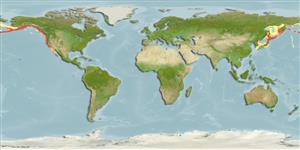
Indo-Pacific and Northwest Atlantic: from Baja California northwest to Alaska and west to Japan. Tropical to boreal.
Μήκος κατά την πρώτη ωρίμανση / Μέγεθος / Βάρος / Ηλικία
Γεννητική Ωρίμανση: Lm ? range ? - ? cm Max length : 300 cm TL αρσενικό/απροσδιόριστο; (Αναφ. 275); μεγ. δημοσιευμένο βάρος: 272.0 kg (Αναφ. 122030)
World's largest octopus species (Refs. 106261, 106263). It's mantle length is to at least 60 cm (Ref. 96968). Common weight: 2,000 to 10,000 g (Ref. 275). Females grow larger than males (Ref. 3722). Radial spread may measure up to 9.8 m (Ref. 99323). Not found in the deep, open ocean (Ref. 106263). It is found on rocky and soft bottoms near a home crevice or cave (Ref. 865) from the low intertidal (Refs. 865, 275), to a depth of 180 meters (Ref. 865). May occur to a depth of possibly 1000 m (Ref. 106261). Also occurs on mud, sand and gravel (Ref. 10624). Found from the coast to the edge of continental shelf. Primarily benthic (Ref. 106254). Generalist predator (Ref. 106264). Mainly consumes crustaceans and mollusks. Preyed upon by large fish and marine mammals (Ref. 106263).
Κύκλος ζωής και συμπεριφορά ζευγαρώματος
Γεννητική Ωρίμανση | Αναπαραγωγή | Γεννοβολία | Αβγά | Γονιμότητα | Προνύμφες
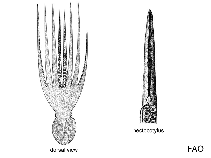
Members of the class Cephalopoda are gonochoric. Male and female adults usually die shortly after spawning and brooding, respectively. Mating behavior: Males perform various displays to attract potential females for copulation. During copulation, male grasp the female and inserts the hectocotylus into the female's mantle cavity where fertilization usually occurs. Life cycle: Embryos hatch into planktonic stage and live for some time before they grow larger and take up a benthic existence as adults.
Roper, C.F.E., M.J. Sweeney and C.E. Nauen 1984 FAO Species Catalogue. Vol. 3. Cephalopods of the world. An annotated and illustrated catalogue of species of interest to fisheries. FAO Fish. Synop. 125(3):277p. Rome: FAO. (Αναφ. 275)
Κατάσταση Κόκκινου Καταλόγου IUCN
(Αναφ. 130435: Version 2025-2 (Global))
Καθεστώς CITES (Αναφ. 108899)
Not Evaluated
Not Evaluated
Απειλή για τον άνθρωπο
Ανθρώπινες χρήσεις
αλιεία: Εμπορικό(ά); δόλωμα: usually
FAO - Publication: search | FishSource | Η θάλασσα γύρω μας
Εργαλεία
Περισσότερες πληροφορίες
Πληθυσμιακή δυναμικήΑύξηση
Μέγιστες ηλικίες / μεγέθη
Μήκος-βάρος σχετ.
Μήκος-μήκος rel.
Μήκος-συχνότητες
Μετατροπή μάζας
Αφθονία
Κύκλος ζωήςΑναπαραγωγήΓεννητική ΩρίμανσηΓονιμότηταΓεννοβολίαΑβγάΑνάπτυξη αυγώνΠρονύμφες ΦυσιολογίαΚατανάλωση οξυγόνου
Ανθρώπινη σχέσηΓραμματόσημα, νομίσματα, διάφορα.
Διαδικτυακές πηγές
Εκτιμήσεις βάσει μοντέλων
Ευπάθεια στην αλιεία
(Αναφ. 71543) |
Very high vulnerability (90 of 100). |
Κατηγορία τιμής
(Αναφ. 80766): |
High. |
Nutrients
|
Calcium = 126 [75, 177] mg/100g; Iron = 4.79 [1.67, 7.92] mg/100g; Protein = 15.5 [13.7, 17.4] %; Omega3 = 0.414 [0.262, 0.566] g/100g; Selenium = 57.8 [48.5, 67.2] μg/100g; VitaminA = 0 μg/100g; Zinc = 1.97 [0.92, 3.02] mg/100g (wet weight); based on nutrient studies. |