Malacostraca |
Decapoda |
Callianassidae
Umwelt: Milieu / Klimazone / Tiefenbereich / Verbreitungsgebiet
Ökologie
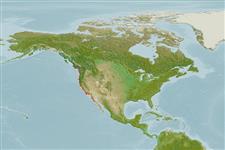
Benthic; brackwasser. Temperate; 51°N - 29°N, 129°W - 115°W (Ref. 4)
Eastern Pacific. Climate: subtropical to temperate.
Länge bei der ersten Reifung / Größe / Gewicht / Alter
Geschlechtsreife: Lm ? range ? - ? cmCommon length : 15.0 cm TL Männchen/unbestimmt; (Ref. 4)
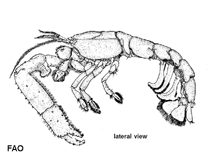
Rostrum a low median angle on the anterior margin of the carapace. Eyes elongate triangularly pointed, reaching with their full length beyond the rostrum. Antennal angles blunt, without spine. Antennal peduncle practically as long as the antennular peduncle. Third maxilliped with merus and ischium strongly expanded forming operculum; the last three segments of the maxilliped less than half as wide as the merus, but not very slender, twice less than twice as long as wide. Large chela of adult male with the concave part of the anterior margin of the part above the base of the fixed finger absent or hardly noticeable. Carpus distinctly longer than palm. Merus with a large and rather wode hook-shaped process in the basal part of the lower margin; in the female this process is reduced to a small triangular tooth. Telson quadrangular, longer than wide and slightly narrowing posteriorly; posterolateral angles rounded. Posterior margin with a small triangular median denticle; no other spines or teeth on telson. Endopod of uropod broad, quadrangular or slightly triangular, with rounded angles and slightly longer than telson (Ref. 4).
Assumed total body length is 12.5 to 15 cm. Habitat: In lower intertidal zone of tidal flats on the sea coast and in estuaries. Behavior: It burrows in soft substrate of sand and mud (Ref. 4).
Lebenszyklus und Paarungsverhalten
Geschlechtsreife | Fortpflanzung | Ablaichen | Eier | Fruchtbarkeit | Larven
Members of the order Decapoda are mostly gonochoric. Mating behavior: Precopulatory courtship ritual is common (through olfactory and tactile cues); usually indirect sperm transfer.
Holthuis, L.B. 1991 FAO Species Catalogue. Vol. 13. Marine lobsters of the world. An annotated and illustrated catalogue of species of interest to fisheries known to date. FAO Fish. Synop. 125(13):292p. Rome: FAO. (Ref. 4)
IUCN Rote Liste Status
(Ref. 130435: Version 2025-2 (Global))
CITES Status (Ref. 108899)
Not Evaluated
Not Evaluated
Bedrohung für Menschen
Nutzung durch Menschen
Köder: usually
FAO - Publication: search | FishSource |
Tools
Mehr Information
Trophische ÖkologieLebensmittel (Beutetiere)
Nahrungszusammensetzung
Nahrungsaufnahme
Räuber
PopulationsdynamikWachstum
Max. Alter/Größen
Länge-Gewicht-Rel.
Länge-Länge-Verhältnis.
Längenhäufigkeiten
Massenkonvertierung
Dichte
LebenszyklusFortpflanzungGeschlechtsreifeFruchtbarkeitAblaichenEierEientwicklungLarven PhysiologieSauerstoffverbrauch
MenschenbezogenBriefmarken, Münzen, Verschiedenes.
Internet Quellen
Schätzungen auf der Grundlage von Modellen
Anfälligkeit der Fischerei
(Ref. 71543) |
(0 of 100). |
Preiskategorie
(Ref. 80766): |
Unknown. |