Bivalvia |
Mytilida |
Mytilidae
Environment: milieu / climate zone / depth range / distribution range
Ecology
Benthic. Tropical; 30°N - 29°S, 114°W - 34°W
Eastern Central Pacific and Western Atlantic: Mexico and Southern Caribbean to southeast Brazil.
Length at first maturity / Size / Weight / Age
Maturity: Lm ?, range 2 - 4.296 cm Max length : 7.0 cm SHL male/unsexed; (Ref. 83435); common length : 9.0 cm SHL male/unsexed; (Ref. 344)
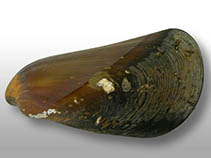
Shell mussel-shaped, elongate, ventral region concave. Oblique ridge runs anterodorsal to posteroventral region of valve. Umbones subterminal. Posterior part of the mantle with branching tentacles. Colour: externally greenish on posterodorsal region (above ridge) and yellowish brown on anteroventral region (below ridge).
Intertidal in bays and protected areas, forming clumps attached to mangrove prop roots or other hard substrates (Ref. 344) via its byssus (Ref. 104222). Attached to mangrove roots, particularly on Rhizophorae mangle (Ref. 104222). Some found to be buried in substrate. Also occurs in a river estuary. Highly tolerant to salinity variations (Ref. 104223). Parasitic on this mussel are Rickettsia-like organisms, Apicomplexa and Platyhelminthes (Ref. 104222). In general, suspension feeding bivalves mainly depend on phytoplankton and detritus material for nutrition (Ref. 107088).
Life cycle and mating behavior
Maturity | Reproduction | Spawning | Eggs | Fecundity | Larvae
Life cycle: Embryos develop into free-swimming trocophore larvae, succeeded by the bivalve veliger, resembling a miniature clam (Ref. 833).
Leal, J.H. 2003 Bivalves. p. 25-98. In Carpenter, K.E. (ed.). The living marine resources of the Western Central Atlantic. Volume 1: Introduction, molluscs, crustaceans, hagfishes, sharks, batoid fishes, and chimaeras. FAO Species Identification Guide for Fishery Purposes and American Society of Ichthyologists and Herpetologists Special Publication No. 5. 1600p. (Ref. 344)
IUCN Red List Status
(Ref. 130435: Version 2025-2 (Global))
CITES status (Ref. 108899)
Not Evaluated
Not Evaluated
Threat to humans
Harmless
Human uses
Fisheries: commercial
FAO - Publication: search | FishSource |
Tools
More information
PhysiologyOxygen consumption
Human RelatedStamps, coins, misc.
Internet sources
Estimates based on models
Fishing Vulnerability
(Ref. 71543) |
Moderate vulnerability (40 of 100). |
Price category
(Ref. 80766): |
Medium. |