Bivalvia |
Pectinida |
Pectinidae
Environment: milieu / climate zone / depth range / distribution range
Ecology
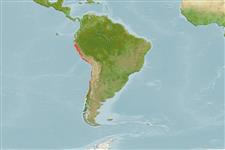
Benthic; depth range 0 - 500 m (Ref. 356). Tropical, preferred 20°C (Ref. 107945); 5°S - 42°S, 81°W - 70°W (Ref. 106891)
Southeast Pacific: From Paita, Peru to Chiloé, Chile. Tropical to subtropical.
Length at first maturity / Size / Weight / Age
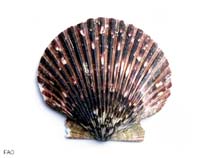
Maturity: Lm ? range ? - ? cm Max length : 12.0 cm ShL male/unsexed; (Ref. 356)
Found in shallow bays (Ref. 106891). Inhabits sedimentary grounds in sheltered areas at depths from 5 to 40 m (Ref. 106862).
Life cycle and mating behavior
Maturity | Reproduction | Spawning | Eggs | Fecundity | Larvae
Life cycle: Embryos develop into free-swimming trocophore larvae, succeeded by the bivalve veliger, resembling a miniature clam (Ref. 833). Spawning occurs year-round but mainly during spring and autumn (Ref. 106788).
SAUP Database 2006 SAUP Database. www.seaaroundus.org. (Ref. 356)
IUCN Red List Status
(Ref. 130435: Version 2025-2 (Global))
CITES status (Ref. 108899)
Not Evaluated
Not Evaluated
Threat to humans
Human uses
Fisheries: commercial; aquaculture: commercial
FAO - Aquaculture Systems: production searchFisheries: landings search; Publication: search | FishSource | Sea Around Us
Tools
More information
Trophic EcologyFood items (preys)
Diet composition
Food consumption
Predators
PhysiologyOxygen consumption
Human RelatedStamps, coins, misc.
Internet sources
Estimates based on models
Resilience
(Ref. 69278): |
High, minimum population doubling time less than 15 months (K=1.99-2.88) |
Fishing Vulnerability
(Ref. 71543) |
Low vulnerability (19 of 100). |
Climate Vulnerability
(Ref. 125649) |
Moderate to high vulnerability (52 of 100) |
Price category
(Ref. 80766): |
Medium. |
Nutrients
|
Calcium = 149 [71, 228] mg/100g; Iron = 8.53 [1.95, 15.11] mg/100g; Protein = 9.88 [8.64, 11.12] %; Omega3 = 0.313 [0.202, 0.423] g/100g; Selenium = 61 [50, 72] μg/100g; VitaminA = 0 μg/100g; Zinc = 2.04 [0.56, 3.51] mg/100g (wet weight); based on nutrient studies. |