Bivalvia |
Venerida |
Mactridae
Environment: milieu / climate zone / depth range / distribution range
Ecology
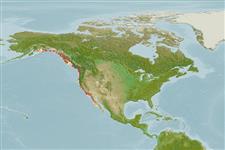
Benthic; depth range 0 - 50 m (Ref. 95344). Temperate; 61°N - 22°N, 156°W - 109°W
Eastern Pacific: from Alaska to Baja California, Mexico.
Length at first maturity / Size / Weight / Age
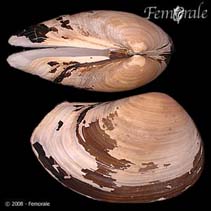
Maturity: Lm 6.8 range ? - ? cm Max length : 25.4 cm SHL male/unsexed; (Ref. 95991); max. reported age: 17 years (Ref. 95991)
It burrows in sand and mud along the intertidal zone from shallow depths to 30 meters (Ref. 865). Prefers sandier areas. Buries deep in the substrate to avoid freezing (Ref. 95344). Feeds on phytoplankton and detritus (Ref. 95991).
Life cycle and mating behavior
Maturity | Reproduction | Spawning | Eggs | Fecundity | Larvae
Reproduction occurs throughout the year during spring, peak months on February and April.
Lamb, A., D. Gibbs and C. Gibbs 2011 Strait of Georgia biodiversity in relation to bull kelp abundance. Pacific Fisheries Resource Conservation Council, 111p. (Ref. 93817)
IUCN Red List Status
(Ref. 130435: Version 2025-2 (Global))
CITES status (Ref. 108899)
Not Evaluated
Not Evaluated
Threat to humans
Human uses
Fisheries: commercial
FAO - Aquaculture Systems: production search; Publication: search | FishSource | Sea Around Us
Tools
More information
PhysiologyOxygen consumption
Human RelatedStamps, coins, misc.
Internet sources
Estimates based on models
Resilience
(Ref. 69278): |
Low, minimum population doubling time 4.5 - 14 years (K=0.12-0.17; tm=3; tmax=17) |
Fishing Vulnerability
(Ref. 71543) |
Moderate vulnerability (45 of 100). |
Price category
(Ref. 80766): |
Medium. |
Nutrients
|
Calcium = 149 [71, 228] mg/100g; Iron = 8.53 [1.95, 15.11] mg/100g; Protein = 9.88 [8.64, 11.12] %; Omega3 = 0.313 [0.202, 0.423] g/100g; Selenium = 61 [50, 72] μg/100g; VitaminA = 0 μg/100g; Zinc = 2.04 [0.56, 3.51] mg/100g (wet weight); based on nutrient studies. |