Bivalvia |
Venerida |
Veneridae
Environment: milieu / climate zone / depth range / distribution range
Ecology
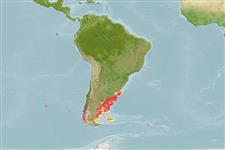
Benthic; depth range 5 - 65 m (Ref. 3446). Subtropical; 11°S - 55°S, 76°W - 51°W (Ref. 3446)
Southwest Atlantic and Southeast Pacific.
Length at first maturity / Size / Weight / Age
Maturity: Lm ?, range 2 - 2.4 cm Max length : 9.3 cm SHL male/unsexed; (Ref. 3446)
Maximum depth from Ref. 87801. The species is under great pressure from exploitation but the population status is unknown (Ref. 87801). It is an infaunal species, found in intertidal areas to a depth of 65 m, in tide pools, sandy, muddy or pebbly and on mussel banks. Gonochoric species with free-living larvae (Ref. 87801).
Life cycle and mating behavior
Maturity | Reproduction | Spawning | Eggs | Fecundity | Larvae
Members of the class Bivalvia are mostly gonochoric, some are protandric hermaphrodites. Life cycle: Embryos develop into free-swimming trocophore larvae, succeeded by the bivalve veliger, resembling a miniature clam.
Rosenberg, G. 2005 Malacolog 4.1: A Database of Western Atlantic Marine Mollusca. [WWW database (version 4.1.0)] URL http://www.malacolog.org/ (Ref. 3446)
IUCN Red List Status
(Ref. 130435: Version 2025-2 (Global))
CITES status (Ref. 108899)
Not Evaluated
Not Evaluated
Threat to humans
Harmless
Human uses
Fisheries: commercial
FAO - Publication: search | FishSource |
Tools
More information
Trophic EcologyFood items (preys)
Diet composition
Food consumption
Predators
Population dynamicsGrowthMax. ages / sizesLength-weight rel.Length-length rel.Length-frequenciesMass conversionAbundance PhysiologyOxygen consumption
Human RelatedStamps, coins, misc.
Internet sources
Estimates based on models
Resilience
(Ref. 69278): |
Medium, minimum population doubling time 1.4 - 4.4 years (K=0.18-0.25) |
Fishing Vulnerability
(Ref. 71543) |
Moderate vulnerability (36 of 100). |