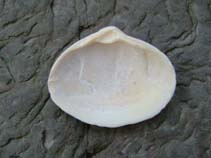
Bivalvia |
Venerida |
Mactridae
Environnement : milieu / zone climatique / profondeur / gamme de distribution
Écologie
Benthic; profondeur 0 - 60 m (Réf. 106944). Subtropical, preferred 10°C (Réf. 107945); 65°N - 32°N, 24°W - 12°E
Eastern Atlantic and the Mediterranean: From southern Iceland to North Sea, Morocco and Madeira to the Mediterranean.
Longueur à la première maturité / Taille / Poids / Âge
Maturité: Lm ? range ? - ? cm Max length : 5.0 cm SHL mâle / non sexé; (Réf. 7882); âge max. reporté: 13 années (Réf. 106244)
Depth based on occurrence (Ref. 2758, p. 805); to be replaced with better reference. Minimum depth from Ref. 2703. Species' maximum length from the Belgian part of the North Sea (Ref. 7882). Found along the coasts and further out into the open sea, mainly on top of sea banks. Shallowly burrows in coarse-grained sediment. A suspension feeder (Ref. 7882).
Cycle de vie et comportement reproducteur
Maturité | Reproduction | Frai | Œufs | Fécondité | Larves
Members of the class Bivalvia are mostly gonochoric, some are protandric hermaphrodites. Life cycle: Embryos develop into free-swimming trocophore larvae, succeeded by the bivalve veliger, resembling a miniature clam.
Gaspar, M.B., M.N. Santos and P. Vasconcelos 2001 Weight-length relationships of 25 bivalve species (Mollusca: Bivalvia) from the Algarve coast (southern Portugal). J. Mar. Biol. Ass. U.K. 81:805-807. (Réf. 2758)
Statut dans la liste rouge de l'IUCN
(Réf. 130435: Version 2025-2 (Global))
statut CITES (Réf. 108899)
Not Evaluated
Not Evaluated
Menace pour l'homme
Utilisations par l'homme
Pêcheries: commercial
FAO - pêcheries: landings search; Publication: search | FishSource | Sea Around Us
Outils
Plus d'informations
Dynamique des populations PhysiologieConsommation d'oxygène
Liées à l'hommeTimbres, pièces de monnaie, divers
Sources Internet
Estimations basées sur des modèles
Résilience
(Ref. 69278): |
Haut, temps minimum de doublement de population inférieur à 15 mois (K=0.23-0.43; tm=1; tmax=13) |
Vulnérabilité de la pêche
(Réf. 71543) |
Moderate vulnerability (37 of 100). |
Vulnérabilité climatique
(Réf. 125649) |
High to very high vulnerability (71 of 100) |
Catégorie de prix
(Réf. 80766): |
Low. |
Nutrients
|
Calcium = 149 [71, 228] mg/100g; Iron = 8.53 [1.95, 15.11] mg/100g; Protein = 9.88 [8.64, 11.12] %; Omega3 = 0.313 [0.202, 0.423] g/100g; Selenium = 61 [50, 72] μg/100g; VitaminA = 0 μg/100g; Zinc = 2.04 [0.56, 3.51] mg/100g (wet weight); based on nutrient studies. |