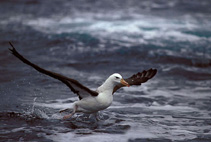
Aves |
Procellariiformes |
Diomedeidae
Environment: milieu / climate zone / depth range / distribution range
Ecology
Others. Subtropical
Pacific Ocean, Northeast Atlantic and the Antarctic. Tropical to polar.
Length at first maturity / Size / Weight / Age
Maturity: Lm ? range ? - ? cm Max length : 88.0 cm TL male/unsexed; (Ref. 84934); max. published weight: 3.8 kg (Ref. 356)
Culmen: 11.86 cm; tarsus: 8.8 cm; wing: 52.2 cm.
A common, widespread species of albatross (Ref. 91362). Found along the continental shelf, in oceanic upwellings, and boundaries of currents (Ref. 356). Forms breeding colonies on grassy cliffs of oceanic islands. Trails ships (Ref. 91362). Feeds by scavenging and surface seizing (Ref. 356);
Life cycle and mating behavior
Maturity | Reproduction | Spawning | Eggs | Fecundity | Larvae
Brooke, M. de L. 1995 The modern avifauna of the Pitcairn Islands. Biological Journal of the Linnean Society 56:199-212. (Ref. 5718)
IUCN Red List Status
(Ref. 130435: Version 2025-2 (Global))
CITES status (Ref. 108899)
Not Evaluated
Threat to humans
Human uses
FAO - Publication: search | FishSource |
Tools
More information
Population dynamicsGrowthMax. ages / sizesLength-weight rel.Length-length rel.Length-frequenciesMass conversionAbundance Life cycleReproductionMaturityFecunditySpawningEggsEgg developmentLarvae PhysiologyOxygen consumption
Human RelatedStamps, coins, misc.
Internet sources
Estimates based on models
Fishing Vulnerability
(Ref. 71543) |
High vulnerability (55 of 100). |
Price category
(Ref. 80766): |
Unknown. |