Articulata |
Terebratulida |
Laqueidae
Environment: milieu / climate zone / depth range / distribution range
Ecology
Reef-associated; depth range 16 - 1250 m (Ref. 2166). Tropical
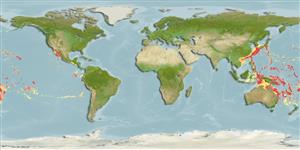
Indo-Pacific: Japan to Australia. Subtropical and tropical.
Length at first maturity / Size / Weight / Age
Maturity: Lm ? range ? - ? cm Max length : 0.9 cm TL male/unsexed; (Ref. 2166)
Always associated with coral reef and may even be found in very shallow water (Ref. 1020). Continental shelf, coral reef, subtidal (Ref. 1456). Filter-feeder (Ref. 68823).
Life cycle and mating behavior
Maturity | Reproduction | Spawning | Eggs | Fecundity | Larvae
Members of the phylum Brachiopoda are gonochoric. Eggs are shed into the water and fertilized at the time of spawning. Life cycle: Eggs develop into free-swimming larvae which later metamorphose into adult.
Bitner, M.A. 2006 First Record od Brachiopods from the Marquesas Islands, French Polynesia, South Central Pacific. Pacific Science, 60(3):417-424. (Ref. 2166)
IUCN Red List Status
(Ref. 130435: Version 2025-2 (Global))
CITES status (Ref. 108899)
Not Evaluated
Not Evaluated
Threat to humans
Human uses
FAO - Publication: search | FishSource |
Tools
More information
Trophic EcologyFood items (preys)
Diet composition
Food consumption
Predators
Population dynamicsGrowth
Max. ages / sizes
Length-weight rel.
Length-length rel.
Length-frequencies
Mass conversion
Abundance
Life cycleReproductionMaturityFecunditySpawningEggsEgg developmentLarvae PhysiologyOxygen consumption
Human RelatedStamps, coins, misc.
Internet sources
Estimates based on models
Fishing Vulnerability
(Ref. 71543) |
Low vulnerability (10 of 100). |
Price category
(Ref. 80766): |
Unknown. |