Cephalopoda |
Vampyromorpha |
Vampyroteuthidae
Entorno: milieu / zona climática / rango de profundidad / gama de distribución
Ecología
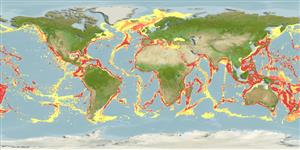
Pelágico; rango de profundidad 100 - 3000 m (Referencia 110525), usually 900 - 1100 m (Referencia 106682). Tropical; 44°N - 35°S, 180°W - 180°E (Referencia 96968)
Circumglobal in tropical and temperate waters.
Longitud en la primera madurez / Tamaño / Peso / Edad
Madurez: Lm ? range ? - ? cm Max length : 13.0 cm ML macho / no sexado; (Referencia 96968)
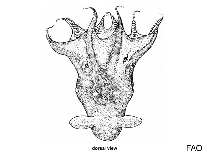
Total length is up to 30 cm (Ref. 96968). One type of a living fossil which showed very little change since it first appeared. The species could turn itself 'inside out' to avoid predators. Inhabits deep waters of open oceans (Ref. 843). Depths range from 600 to 1,200 m. This is a mid-water species. The long filaments in pits between the first two arm pairs may be used to feel for or chemically detect prey. Live animals observed in situ typically orient in the water column with the dorsal mantle surface facing upwards and one filament extended well beyond the arms. Disturbed animals pull the arms and web over their body to take on an inverted shape that exposes the black skin and cirri, on the oral surfaces of the webs. In addition to the large four photophores, this species can produce light on its arm tips and squirt luminous clouds from the arm tips consisting of discrete glowing particles, which can glow for up to 10 minutes (Ref. 96968).
Ciclo vital y comportamiento de apareamiento
Madurez | Reproducción | Puesta | Huevos | Fecundidad | Larva
Members of the class Cephalopoda are gonochoric. Male and female adults usually die shortly after spawning and brooding, respectively. Mating behavior: Males perform various displays to attract potential females for copulation. During copulation, male grasp the female and inserts the hectocotylus into the female's mantle cavity where fertilization usually occurs. Life cycle: Embryos hatch into planktonic stage and live for some time before they grow larger and take up a benthic existence as adults.
Jereb, P., C.F.E. Roper, M.D. Norman and J.K. Finn 2014 Cephalopods of the world. An Annotated and Illustrated catalogue of Cephalopod species known to date. Vol. 3. Octopods and vampire squids. FAO Species Catalogue for Fishery Purposes 3(4):370p. (Referencia 96968)
Situación en la Lista Roja de la UICN
(Referencia 130435: Version 2025-2 (Global))
Estatus CITES (Referencia 108899)
Not Evaluated
CMS (Referencia 116361)
Not Evaluated
Amenaza para el ser humano
Usos humanos
FAO - Publication: search | FishSource |
Herramientas
Más información
Dinámica de la poblaciónCrecimientoEdades / tallas máximasLongitud-peso rel.Longitud-longitud rel.Longitud-frecuenciasConversión de masasAbundancia Ciclo de vidaReproducciónMadurezFecundidadPuestaHuevosDesarrollo de los huevosLarva FisiologíaConsumo del oxígeno
Relacionados con el ser humanoSellos, monedas, varios
Fuentes de Internet
Estimaciones basadas en modelos
Vulnerabilidad pesquera
(Referencia 71543) |
Low vulnerability (10 of 100). |
Categoría de precios
(Referencia 80766): |
Unknown. |