Pycnogonida |
Pantopoda |
Ammotheidae
Environnement : milieu / zone climatique / profondeur / gamme de distribution
Écologie
Benthic; profondeur 0 - 25 m (Réf. 2115). Tropical
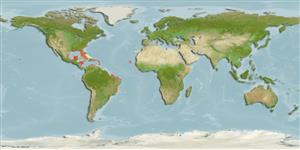
Western and Central Atlantic: Belize, Cape Verde, Curacao Islands and USA.
Longueur à la première maturité / Taille / Poids / Âge
Maturité: Lm ? range ? - ? cm
Description synthétique
Morphologie
Lateral processes with tall, slender dorsodistal tubercles, without lateral tubercles. Ocular tubercle with 6 long, slender spines radiating from tip. Abdomen with distal corona of long, slender spines. Chelifore scape second segment with row of similar spines. First coxae with slender anterodistal tubercles and larger posterodistal tubercles, each bearing long, slender spine, lacking on posterior pair of coxae. Major leg segments with several very long spines, the longer ones usually bearing many lateral setules. Femoral cement gland originating in tiny proximo- ventral bulge with slender tube projecting laterally (Ref. 2115, p. 27-28).
Coastal to shelf (Ref. 1951, page 2). Epibiotic (Ref. 116112).
Cycle de vie et comportement reproducteur
Maturité | Reproduction | Frai | Œufs | Fécondité | Larves
Members of the class Pycnogonida are gonochoric and sexually dimorphic. During copulation, male usually suspends itself beneath the female. Fertilization occurs as the eggs leave the female's ovigers. Males brood the egg masses until they hatch. Life cycle: Eggs hatch into protonymphon larva then to adults.
Arango, C.P. 2002 Morphological phylogenetics of the sea spiders (Arthropoda: Pycnogonida). Organisms Diversity and Evolution 2(2):119-126. (Réf. 1951)
Statut dans la liste rouge de l'IUCN
(Réf. 130435: Version 2025-2 (Global))
statut CITES (Réf. 108899)
Not Evaluated
Not Evaluated
Menace pour l'homme
Utilisations par l'homme
FAO - Publication: search | FishSource |
Outils
Plus d'informations
Écologie trophiqueAliments (proies)
Composition du régime alimentaire
Consommation alimentaire
Prédateurs
Dynamique des populationsCroissance
Âges / tailles maximales
Longueur-poids rel.
Rel. longueur-longueur.
Fréquences de longueurs
Conversion de masse
Abondance
Cycle de vieReproductionMaturitéFéconditéFraiŒufsDéveloppement de l'œufLarves PhysiologieConsommation d'oxygène
Liées à l'hommeTimbres, pièces de monnaie, divers
Sources Internet
Estimations basées sur des modèles
Vulnérabilité de la pêche
(Réf. 71543) |
(0 of 100). |
Catégorie de prix
(Réf. 80766): |
Unknown. |