Demospongiae |
Dictyoceratida |
Irciniidae
Miljö: miljö / Klimatzon / djupintervall / distributionsområde
Ekologi
Sessile; brackvatten; djupintervall 1 - 100 m (Ref. 108813). Tropical; 25°C - 33°C (Ref. 86836)
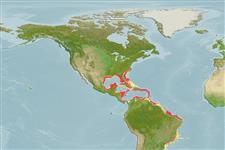
Western Atlantic: Caribbean and Gulf of Mexico.
Längd vid första mognad / Storlek / Vikt / Ålder
Könsmognad: Lm ? range ? - ? cm Max length : 0.2 cm H hane/ej könsbestämd; (Ref. 415)
Variable growth forms: massive-amorphous, globular, thickly encrusting, flabellate or irregularly branching. Reddish-brown to grey externally; tan internally. Conulose surface: 0.1 - 0.2 cm cm high; 0.2 - 0.3 cm apart. Membrane-bearing oscules: 0.1 - 0.8 cm wide; with white or dark rims, scattered. Compressible; rubbery, extremely tough to be cut. Spicules absent (Ref. 415, 85482).
Common on mangroves (Ref. 415). Massive forms usually found on reefs; while branching and more lobate forms inhabit quieter shallow inshore hard bottoms, sediment and seagrass beds (Ref. 85482).
Livscykel och parningsbeteende
Könsmognad | Reproduktion | Lek | Ägg | Fekunditet | Larver
Members of the class Demospongiae are hermaphroditic. Life cycle: The zygote develops into parenchymella larva (free-swimming) before settling down on a substrate where it grows into a young sponge.
Collin, R., M.C. Díaz, J. Norenburg, R.M. Rocha, J.A. Sánchez, M. Schulze, A. Schwartz and A. Valdés 2005 Photographic identification guide to some common marine invertebrates of Bocas Del Toro, Panama. Caribbean Journal of Science. 41(3):638-707. (Ref. 415)
Status på IUCN:s rödlista
(Ref. 130435: Version 2025-2 (Global))
CITES-status (Ref. 108899)
Not Evaluated
Not Evaluated
Hot mot människor
Mänskliga användningsområden
FAO - Publication: search | FishSource |
Verktyg
Ytterligare information
Trofisk ekologiLivsmedelsartiklar (preys)
Födosammansättning
Födointag
Predatorer
LivscykelReproduktionKönsmognadFekunditetLekÄggUtveckling av äggLarver MänniskorelateradFrimärken, mynt, diverse.
Internet-källor
Uppskattningar baserade på modeller
Sårbarhet i fisket
(Ref. 71543) |
Low vulnerability (10 of 100). |
Priskategori
(Ref. 80766): |
Unknown. |