Holothuroidea |
Holothuriida |
Holothuriidae
Milieu: milieu / Klimaatzone / Diepte / verspreidingsgebied
Ecologie
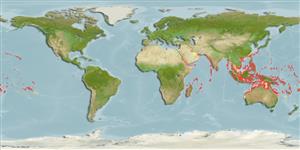
Rifbewoner; diepte 0 - 45 m (Ref. 800). Tropical; 30°N - 30°S, 32°E - 108°W (Ref. 85013)
Indo-Pacific: Red Sea and Madagascar, north to Japan, east to Hawaii and Easter Island, south to Australia. Tropical and subtropical.
Lengte bij maturiteit / Grootte / Gewicht / Leeftijd
Maturiteit: Lm ?, range 26 - ? cm Max length : 60.0 cm TL mannelijk / geslacht onbekend; (Ref. 800); common length : 37.0 cm TL mannelijk / geslacht onbekend; (Ref. 122); max. gepubliceerd gewicht: 4.0 kg (Ref. 122)
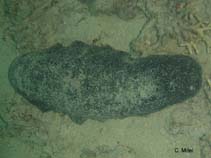
Maximum width: 15 cm (Ref. 418). Mean live wt. 1700 up to 4000 g; body-thickness 0.12 cm. Body: sub oval, stout, firm and rigid, arched dorsally (bivium), and flattened ventrally (trivium). Bivium with characteristic large lateral papillae (teats) and often covered by sand. Bivium with small papillae as well as posia ending in a disc around 0.022 cm in diameter; podia on trivium stout, arranged irregularly, their calcareous disc around 0.07 cm in diameter. Mouth ventral, surrounded by 2 rows of black papillae and 20 grey, stout tentacles. Anus surrounded by short papillae and 5 stout calcareous teeth. Calcareous ring with large wing0shaped radial pieces and narrow sharp interradials (slightly different from Holothuria fuscogilva). Cuverian tubules present, but never expelled. Color: less variable than in Holothuria fuscogilva; bivium dark brown to black; trivium lighter, generally grayish. Spicules: in form of tables and buttons; only one kind of tables in the dorsal and ventral tegument; tables with undulated, circular disc with 12 to 16 holes, supporting a massive spire with 4 pillars and a cross bridge, ending in a large, spiny crown; ventral-tegument buttons in form of fenestrated ellipsoids; dorsal-tegument buttons shorter, larger, and less fenestrated; ventral podia with numerous spiny rods and large multiperforated plates; tentacles with spiny rods, large plates, small plates, and pseudo-plates (Ref. 122).
Maximum depth from Ref. 85013. Populations reach higher densities, with medium densities of around 0.002 per square meter. Harvested in artisanal fisheries throughout the area, in places were its habitat occurs. Collected by hand at low tide, by skin diving or using diving gear (if not banned), making the populations very vulnerable, due to overexploitation. The processed product is of major commercial value and very highly demanded at present, even though the stocks have declined within the area (Ref. 122). Inhabits shallower waters than Holothuria fuscogilva, mostly found from the surface to a depth of 20 m; generally occurs on reef flats, slopes and in shallow seagrass beds (Ref. 122). Found in shallow waters in lagoons, and common on shallow reef bottoms that are not subject to terrigenous influence (Ref. 118). Some prefer closer to the reef crest. On sandy hard substrate; some found in coarse sand (Ref. 102863). Juveniles are found on turtle-grass beds (Ref. 118). Generally solitary (Ref. 102863). Burrows (Ref. 115900). Deposit feeder (Ref. 833). Associated with coral communities (Ref. 129602).
Long spawning period that takes place during the cold season (Ref. 99891). It has a medium potential fecundity (Ref. 122).
Conand, C. 1998 Holothurians (sea cucumbers, Class Holothuroidea). p. 1157-1190. In Carpenter, K.E. and V.H. Niem (eds.) FAO Species Identification Guide for Fishery Purposes. The Living Marine Resources of the Western Central Pacific. Vol. 2. Cephalopods, crustaceans, holothurians and sharks. FAO Rome. (Ref. 122)
Status op de Rode Lijst van het IUCN
(Ref. 130435: Version 2025-2 (Global))
CITES status (Ref. 108899)
Not Evaluated
Gevaar voor de mens
Gebruik door de mens
Visserij: van groot commercieel belang
FAO - visserij: landings search; Publication: search | FishSource |
Tools
Meer informatie
Trofische ecologieVoedsel (prooien)
Dieetsamenstelling
Voedselconsumptie
Predatoren
FysiologieZuurstofverbruik
Menselijk gerelateerdPostzegels, munten, diversen.
Internetbronnen
Schattingen op basis van modellen
Kwetsbaarheid van de visserij
(Ref. 71543) |
Moderate to high vulnerability (53 of 100). |
Prijsklasse
(Ref. 80766): |
Unknown. |