Bivalvia |
Cardiida |
Semelidae
Umwelt: Milieu / Klimazone / Tiefenbereich / Verbreitungsgebiet
Ökologie
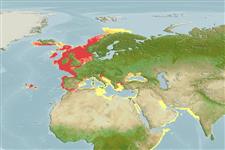
Benthic; brackwasser; tiefenbereich 0 - 521 m (Ref. 108343). Temperate; 72°N - 12°N, 19°W - 62°E
Western Indian Ocean, Northeast Atlantic and the Mediterranean. Subtropical.
Länge bei der ersten Reifung / Größe / Gewicht / Alter
Geschlechtsreife: Lm ? range ? - ? cm Max length : 2.5 cm SHL Männchen/unbestimmt; (Ref. 7882)
Species' maximum length from the Belgian part of the North Sea (Ref. 7882). Inhabit sandbanks and inshore areas (Ref. 96352). Common in near-coastal zone, rarely further than 30 km off the coast. Found buried deep in almost all sediment types but prefer fine-grained to muddy substrates; rare in coarse substrates. Feeds through its long, individually separated and stretchable siphons (Ref. 7882). Known as a surface deposit feeder (Refs. 96214, 96292).
Lebenszyklus und Paarungsverhalten
Geschlechtsreife | Fortpflanzung | Ablaichen | Eier | Fruchtbarkeit | Larven
Members of the class Bivalvia are mostly gonochoric, some are protandric hermaphrodites. Life cycle: Embryos develop into free-swimming trocophore larvae, succeeded by the bivalve veliger, resembling a miniature clam.
Degraer, S., J. Wittoeck, W. Appeltans, K. Cooreman, T. Deprez, H. Hillewaert, K. Hostens, J. Mees, E. Vanden Berghe and M. Vincx 2006 The macrobenthos atlas of the Belgian part of the North Sea. Belgian Science Policy. (Ref. 7882)
IUCN Rote Liste Status
(Ref. 130435: Version 2025-2 (Global))
CITES Status (Ref. 108899)
Not Evaluated
Not Evaluated
Bedrohung für Menschen
Nutzung durch Menschen
FAO - Publication: search | FishSource |
Tools
Mehr Information
LebenszyklusFortpflanzungGeschlechtsreifeFruchtbarkeitAblaichenEierEientwicklungLarven PhysiologieSauerstoffverbrauch
MenschenbezogenBriefmarken, Münzen, Verschiedenes.
Internet Quellen
Schätzungen auf der Grundlage von Modellen
Widerstandsfähigkeit
(Ref. 69278): |
hoch, Verdopplung der Population dauert weniger als 15 Monate. (K=1.22) |
Anfälligkeit der Fischerei
(Ref. 71543) |
Low vulnerability (10 of 100). |
Preiskategorie
(Ref. 80766): |
Unknown. |