Hexacorallia |
Scleractinia |
Astrocoeniidae
Milieu: milieu / Klimaatzone / Diepte / verspreidingsgebied
Ecologie
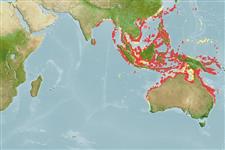
Rifbewoner; diepte 2 - 35 m (Ref. 100893). Tropical; 30°N - 31°S, 81°E - 157°E (Ref. 847)
Indo-West Pacific.
Lengte bij maturiteit / Grootte / Gewicht / Leeftijd
Maturiteit: Lm ? range ? - ? cm
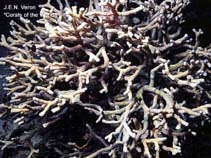
Colonies are branching with anastomosing blunt-ended non-tapering branches. Corallites are immersed, circular, with blunt style-like columellae and two unequal cycles of septa. Cream or pinkish brown in color. Corallites appear star-like in close inspection.
Restricted to turbid and sandy substrates in Australia but found on upper reef slopes in equatorial countries (Ref. 847). Has low bleaching level and low estimated mortality in Palau (Ref. 66144).
Levenscyclus en paargedrag
Maturiteit | Voortplanting | Paaien | Eieren | Fecunditeit | Larven
Members of the class Anthozoa are either gonochoric or hermaphroditic. Mature gametes are shed into the coelenteron and spawned through the mouth. Life cycle: The zygote develops into a planktonic planula larva. Metamorphosis begins with early morphogenesis of tentacles, septa and pharynx before larval settlement on the aboral end.
Veron, J.E.N. 2000 Corals of the world. Volume 2. Australian Institute of Marine Science and CRR Qld. Pty. Ltd. Australia. 429 p. (Ref. 847)
Status op de Rode Lijst van het IUCN
(Ref. 130435: Version 2025-2 (Global))
CITES status (Ref. 108899)
Not Evaluated
Gevaar voor de mens
Gebruik door de mens
FAO - Publication: search | FishSource |
Tools
Meer informatie
Trofische ecologieVoedsel (prooien)
Dieetsamenstelling
Voedselconsumptie
Predatoren
PopulatiedynamicaGroeiMax. leeftijden / matenLengte-gewicht rel.Lengte-lengte rel.LengtefrequentiesMassaconversieAbundantie LevenscyclusVoortplantingMaturiteitFecunditeitPaaienEierenOntwikkeling van de eierenLarven FysiologieZuurstofverbruik
Menselijk gerelateerdPostzegels, munten, diversen.
Internetbronnen
Schattingen op basis van modellen
Kwetsbaarheid van de visserij
(Ref. 71543) |
(0 of 100). |
Prijsklasse
(Ref. 80766): |
Unknown. |