Hexacorallia |
Actiniaria |
Hormathiidae
Milieu: milieu / Klimaatzone / Diepte / verspreidingsgebied
Ecologie
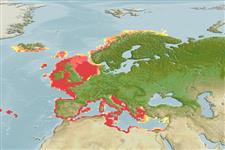
Sessile. Subtropical
Atlantic and the Mediterranean.
Lengte bij maturiteit / Grootte / Gewicht / Leeftijd
Maturiteit: Lm ? range ? - ? cm
Column Size: 8 to 10 cm in height. Column: robust and cylindrical. Color: whitish or yellowish, with a dozen broad longitudinal brown scratches. Tentacles: 3 cm long; yellow gray, slightly transparent; they are numerous. Aconties: long irritant purple filaments; projected with each shock or contact (Ref. 364).
Column Size: 8 to 10 cm in height. Fishing is done artisanalement, with the dredger. Consumed primarily in Sicily. The species meets on all the Mediterranean circumference between a few meters and a hundred meters, on sandy-muddy or detrital substrates (Ref. 364). Known from infra- and circalittoral as well as bathyal zones (Ref. 85338). Solitary (Ref. 2377).
Levenscyclus en paargedrag
Maturiteit | Voortplanting | Paaien | Eieren | Fecunditeit | Larven
Members of the class Anthozoa are either gonochoric or hermaphroditic. Mature gametes are shed into the coelenteron and spawned through the mouth. Life cycle: The zygote develops into a planktonic planula larva. Metamorphosis begins with early morphogenesis of tentacles, septa and pharynx before larval settlement on the aboral end.
Carpine, C. 1987 Cnidairies (Meduses, Actinies et Coraux). p. 147 - 166. In Fischer, W., M. L. Bauchot and M. Schneider. 1987. Fiches FAO d' identification des espèces pour les besoins de la pêche. (Revision 1). Méditerranée et mer Noire. Zone de pêche 37. Volume I. Végëtaux et Invertébrés. Publication préparée par la FAO, résultant d'un accord entre la FAO et la Commission des Communautés européennes (Project GCP/INT/422/EEC) financëe conjointement par ces deux organisations. Rome, FAO, Vol.1. (Ref. 364)
Status op de Rode Lijst van het IUCN
(Ref. 130435: Version 2025-2 (Global))
CITES status (Ref. 108899)
Not Evaluated
Not Evaluated
Gevaar voor de mens
Gebruik door de mens
FAO - Publication: search | FishSource |
Tools
Meer informatie
Trofische ecologieVoedsel (prooien)
Dieetsamenstelling
Voedselconsumptie
Predatoren
PopulatiedynamicaGroei
Max. leeftijden / maten
Lengte-gewicht rel.
Lengte-lengte rel.
Lengtefrequenties
Massaconversie
Abundantie
LevenscyclusVoortplantingMaturiteitFecunditeitPaaienEierenOntwikkeling van de eierenLarven FysiologieZuurstofverbruik
Menselijk gerelateerdPostzegels, munten, diversen.
Internetbronnen
Schattingen op basis van modellen
Kwetsbaarheid van de visserij
(Ref. 71543) |
(0 of 100). |
Prijsklasse
(Ref. 80766): |
Unknown. |