Copepoda |
Calanoida |
Acartiidae
Environment: milieu / climate zone / depth range / distribution range
Ecology
Pelagic; brackish; pH range: 0.3 - 36.9; depth range 0 - 50 m (Ref. 111077). Temperate; -1°C - 32°C (Ref. 137519); 48°N - 45°S, 98°W - 34°W
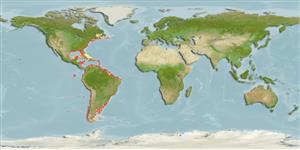
Western Atlantic: from Belize north to Canada and south to Argentina. Introduced in the Eastern Atlantic and the Mediterranean.
Length at first maturity / Size / Weight / Age
Maturity: Lm ? range ? - ? cm
Euryhaline (Ref. 111077). This species is found in marine and brackish areas (Ref. 87872), and is dominant in embayment's, estuaries, fjords, sounds and inner channel systems (Ref. 137519). Feeds on phytoplankton and ciliates, by suspension feeding and ambush feeding, respectively (Ref. 95842).
Life cycle and mating behavior
Maturity | Reproduction | Spawning | Eggs | Fecundity | Larvae
Members of the subclass Copepoda are gonochoric and sexually dimorphic. During copulation, male glues spermatophores to the female's venter. Life cycle: Eggs undergo six naupliar and five larval stages before becoming an adult.
Markowski, S. 1962 Faunistic and ecological investigations in Cavendish Dock, Barrow-In-Furness. The Journal of Animal Ecology 31(1):43-51. (Ref. 2802)
IUCN Red List Status
(Ref. 130435: Version 2025-2 (Global))
CITES status (Ref. 108899)
Not Evaluated
Not Evaluated
Threat to humans
Human uses
FAO - Publication: search | FishSource |
Tools
More information
Trophic EcologyFood items (preys)Diet compositionFood consumptionPredators Life cycleReproductionMaturityFecunditySpawningEggsEgg developmentLarvae PhysiologyOxygen consumption
Human RelatedStamps, coins, misc.
Internet sources
Estimates based on models
Fishing Vulnerability
(Ref. 71543) |
(0 of 100). |
Price category
(Ref. 80766): |
Unknown. |