Gastropoda |
Not assigned |
Lottiidae
Milieu: milieu / Klimaatzone / Diepte / verspreidingsgebied
Ecologie
Benthic. Subtropical
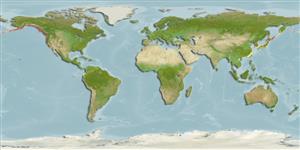
Pacific Ocean: Alaska to Mexico. Boreal to tropical.
Lengte bij maturiteit / Grootte / Gewicht / Leeftijd
Maturiteit: Lm ? range ? - ? cm Max length : 5.4 cm SHL mannelijk / geslacht onbekend; (Ref. 95344); common length : 4.0 cm SHL mannelijk / geslacht onbekend; (Ref. 312)
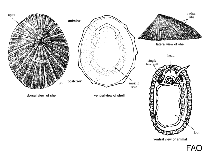
Apex near center, irregular ribbed slopes. Some possess a brown colored shell with alternating brown and white checks at the edge. Other colorations of this limpet exist and can be found in the same area. Both the substrate the limpet lives and its diet determine the color of its shell (Ref. 312).
It has a shell length of 4 cm (Ref. 312). Maximum shell height at 1.5 cm (Ref. 95344). Occurs in the middle to high intertidal zone (Ref. 312); common from the low to mid-intertidal; the largest individuals are found lower on the shore farthest from effect of wave action (Ref. 310). Non-selective herbivores, consuming a wide variety of algae (Ref. 312). Commonly found in mussel beds and associated with brown algae (e.g., the sea palm, Postelsia)
Levenscyclus en paargedrag
Maturiteit | Voortplanting | Paaien | Eieren | Fecunditeit | Larven
Members of the order Patellogastropoda are mostly gonochoric and broadcast spawners. Life cycle: Embryos develop into planktonic trocophore larvae and later into juvenile veligers before becoming fully grown adults.
Gallivan, G. and J. Danforth 1999 Phylum Mollusca. Marine Science Institute. (Ref. 312)
Status op de Rode Lijst van het IUCN
(Ref. 130435: Version 2025-2 (Global))
CITES status (Ref. 108899)
Not Evaluated
Not Evaluated
Gevaar voor de mens
Gebruik door de mens
FAO - Publication: search | FishSource |
Tools
Meer informatie
Trofische ecologieVoedsel (prooien)
Dieetsamenstelling
Voedselconsumptie
Predatoren
PopulatiedynamicaGroei
Max. leeftijden / maten
Lengte-gewicht rel.
Lengte-lengte rel.
Lengtefrequenties
Massaconversie
Abundantie
LevenscyclusVoortplantingMaturiteitFecunditeitPaaienEierenOntwikkeling van de eierenLarven FysiologieZuurstofverbruik
Menselijk gerelateerdPostzegels, munten, diversen.
Internetbronnen
Schattingen op basis van modellen
Kwetsbaarheid van de visserij
(Ref. 71543) |
Low vulnerability (10 of 100). |
Prijsklasse
(Ref. 80766): |
Unknown. |