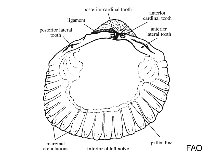
Bivalvia |
Cardiida |
Cardiidae
Environment: milieu / climate zone / depth range / distribution range
Ecology
Benthic; depth range 0 - 1 m (Ref. 117184). Tropical
Western Indian Ocean: Cargados Carajos.
Length at first maturity / Size / Weight / Age
Maturity: Lm ? range ? - ? cm Max length : 26.0 cm SHL male/unsexed; (Ref. 117184)
It is free-living on sand and loose rubble (Ref. 117184).
Life cycle and mating behavior
Maturity | Reproduction | Spawning | Eggs | Fecundity | Larvae
Neo, M.L., C.C.C. Wabnitz, R.D. Braley, G.A. Heslinga, C. Fauvelot, S. Van Wynsberge, S. Andrefouet, C. Waters, A.S.-H. Tan, E.D. Gomez, M.J. Costello and P.A. Todd 2017 Giant clams (Bivalvia: Cardiidae: Tridacninae): a comprehensive update of species and their distribution, current threats and conservation status. Oceanography and Marine Biology: An Annual Review 55:2-303. (Ref. 117184)
IUCN Red List Status
(Ref. 130435: Version 2025-2 (Global))
CITES status (Ref. 108899)
Not Evaluated
Threat to humans
Harmless
Human uses
FAO - Publication: search | FishSource |
Tools
More information
Trophic EcologyFood items (preys)
Diet composition
Food consumption
Predators
Population dynamicsGrowth
Max. ages / sizes
Length-weight rel.
Length-length rel.
Length-frequencies
Mass conversion
Abundance
Life cycleReproductionMaturityFecunditySpawningEggsEgg developmentLarvae PhysiologyOxygen consumption
Human RelatedStamps, coins, misc.
Internet sources
Estimates based on models
Fishing Vulnerability
(Ref. 71543) |
Low vulnerability (16 of 100). |