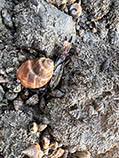
Gastropoda |
Neogastropoda |
Babyloniidae
Environnement : milieu / zone climatique / profondeur / gamme de distribution
Écologie
Benthic; profondeur 0 - 60 m (Réf. 3204). Tropical; 29°N - 9°S, 48°E - 116°E
Indo-West Pacific: from Persian Gulf, Saudi Arabia to India and Hong Kong, south to Java and Bali, Indonesia.
Longueur à la première maturité / Taille / Poids / Âge
Maturité: Lm ? range ? - ? cm Max length : 4.9 cm SHH mâle / non sexé; (Réf. 126558)
Description synthétique
Morphologie
Characterized by broad, ovately conical and moderately short shell; spire prominent and pointed; sutural canal conspicuous, wide and deep with angulate keel-like shoulder; body whorl somewhat flattened between the shoulder and above the periphery; aperture about half of shell height; umbilicus varying from wide open to completely closed. Ground colour white; blotches of varying shapes and sizes that are generally arranged in spiral bands, ranging from pinkish-orange to dark brown; periostracum thin, brown.
Maximum depth from Ref. 799. Found on mud, fine sand and shell substrates (Refs. 3204, 126558). Also found amongst seagrass bed during the evening low spring tide (Ref. 126558).
Cycle de vie et comportement reproducteur
Maturité | Reproduction | Frai | Œufs | Fécondité | Larves
This species is a non-broadcast spawner. Life cycle does not include trocophore stage. Also Ref. 833.
The Academy of Natural Sciences 2006 OBIS Indo-Pacific Molluscan Database. http://data.acnatsci.org/obis/find_mollusk.html [accessed 21/03/2007]. (Réf. 3204)
Statut dans la liste rouge de l'IUCN
(Réf. 130435: Version 2025-2 (Global))
statut CITES (Réf. 108899)
Not Evaluated
Not Evaluated
Menace pour l'homme
Harmless
Utilisations par l'homme
FAO - pêcheries: landings search; Publication: search | FishSource |
Outils
Plus d'informations
Dynamique des populations Cycle de vieReproductionMaturitéFéconditéFraiŒufsDéveloppement de l'œufLarves PhysiologieConsommation d'oxygène
Liées à l'hommeTimbres, pièces de monnaie, divers
Sources Internet
Estimations basées sur des modèles
Résilience
(Ref. 69278): |
Haut, temps minimum de doublement de population inférieur à 15 mois (K=0.42) |
Vulnérabilité de la pêche
(Réf. 71543) |
Low vulnerability (24 of 100). |