This website uses cookies to enhance your browsing experience and ensure the functionality of our site. For more detailed information about the types of cookies we use and how we protect your privacy, please visit our Privacy Information page..
×
Cookie Settings
This website uses different types of cookies to enhance your experience. Please select your preferences below:
Performance
These cookies help us understand how visitors interact with our website by collecting and reporting information anonymously. For example, we use Google Analytics to generate web statistics, which helps us improve our website's performance and user experience. These cookies may track information such as the pages visited, time spent on the site, and any errors encountered.
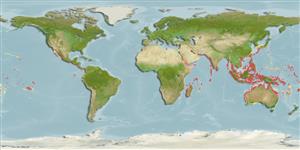
Indian Ocean: from Iran to Madagascar, including the Persian Gulf, Aldabra, Seychelles, Mauritius and Réunion, east to India and south to Indonesia including Laccadive and Andaman Islands; Pacific Ocean: from China to the South China Sea south to Queensland, Australia including Federated States of Micronesia, Solomon Islands and Fiji, east to the Samoan Archipelago.
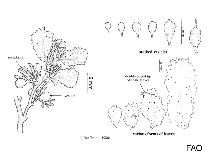
Thalli erect, yellowish brown to dark brown in colour, attached by coarse branched holdfasts to rocky substrate, forming thick, huge colonies. Axes terete, muricate at the basal portion. Leaves are 6 to 12 mm long, consisting of a stalk, small vesicles and an expanded distal marginal blade outlined by coarse teeth; leaves triangular in outline or irregularly rounded in surface view; 3.5 to 9.0 mm across, sometimes deeply cut on one side, the cut often reaching the vesicle. Receptacular clusters 3 to 10 mm long, generally shorter and attached to the stalk of the leaves at 1/4 the distance from the main axis. This species is easily distinguished by its lax branched thalli, numerous branches, and small turbinate leaves with a length of about 1 cm or less. Thalli up to 1.5 m in height (Ref. 80758).
Used for human consumption, as fertilizer and insect repellant; contains minerals (Ca, K, Mg, Na, Cu, Fe, Zn); source of algin, tannins and phenols (Ref. 80758). Thrives mostly on sandy coralline bottoms on reef portions which are not exposed to excessive water turbulence; usually in shallow lagoons or tidepools in subtidal habitats protected from strong wave action (Ref. 80758).
Guiry, M.D. and G.M. Guiry 2009 AlgaeBase. World-wide electronic publication, National University of Ireland, Galway. http://www.algaebase.org; searched on 14 April 2009. (參考文獻 80701)