Phaeophyceae |
Fucales |
Sargassaceae
Environnement : milieu / zone climatique / profondeur / gamme de distribution
Écologie
Sessile; profondeur 0 - 63 m (Réf. 102119). Tropical
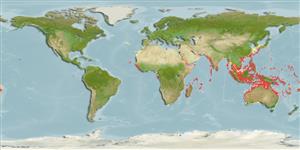
Atlantic and Indo-Pacific oceans: Canary Islands; from Kenya to Madagascar, including Seychelles and Mauritius, east to India and south to Indonesia, including Bay of Bengal and Andaman Islands; from China to the South China Sea, south to Australia, including Xisha Islands, Guam, Northern Mariana Islands, Federated States of Micronesia, New Caledonia, Tonga and Fiji.
Longueur à la première maturité / Taille / Poids / Âge
Maturité: Lm ? range ? - ? cm
Description synthétique
Morphologie
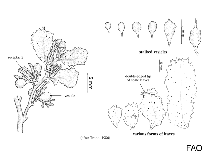
Thalli large, dark brown to yellowish brown, attached to rocks by a coarse branching holdfast; stem short cylindrical. Primary branches terete, bearing irregularly alternate secondary branches with numerous simple and Y-shaped proliferations. Mature thalli with fewer and smaller oblanceolate leaves, 7 to 15 mm long and 1.5 to 4 mm wide, with coarsely dentate or serrated margins; midrib prominent up to near the apex. Cryptostomata scattered on the surface of leaves. Stalked vesicles ovate or spherical, numerous; vesicles attached to the secondary, tertiary and terminal branches either singly or in clusters, 1.0 to 2.5 mm in diameter, bearing few cryptostomata and/or teeth-like structures. Plant dioecious. Male receptacles racemose-paniculate, receptacular branches terete, warty. Female receptacles small, cymose; receptacular branches short, dense, compressed, simple or forked with teeth or spines at margins. Thalli up to 40 cm in height (Ref. 80758).
Used as fertilizer, as human food, fodder and medicine; contains auxin-like substance; controls heavy metal (Pb, Cd) pollution; also a source of alginate; may form dense stands and is therefore considered as a good biomass source for biogas production; used as soil fertilizer (Ref. 80758). Usually thrives in inner reef areas on coarse, sandy coralline substrate, not exposed to strong water turbulence (Ref. 80758).
Cycle de vie et comportement reproducteur
Maturité | Reproduction | Frai | Œufs | Fécondité | Larves
Guiry, M.D. and G.M. Guiry 2009 AlgaeBase. World-wide electronic publication, National University of Ireland, Galway. http://www.algaebase.org; searched on 14 April 2009. (Réf. 80701)
Statut dans la liste rouge de l'IUCN
(Réf. 130435: Version 2025-2 (Global))
statut CITES (Réf. 108899)
Not Evaluated
Not Evaluated
Menace pour l'homme
Utilisations par l'homme
Pêcheries: commercial
FAO - Publication: search | FishSource |
Outils
Plus d'informations
Écologie trophiqueAliments (proies)
Composition du régime alimentaire
Consommation alimentaire
Prédateurs
Dynamique des populationsCroissance
Âges / tailles maximales
Longueur-poids rel.
Rel. longueur-longueur.
Fréquences de longueurs
Conversion de masse
Abondance
Cycle de vieReproductionMaturitéFéconditéFraiŒufsDéveloppement de l'œufLarves PhysiologieConsommation d'oxygène
Liées à l'hommeTimbres, pièces de monnaie, divers
Sources Internet
Estimations basées sur des modèles
Vulnérabilité de la pêche
(Réf. 71543) |
(0 of 100). |